

Introduction
Cold storage facilities are vital for industries like food preservation, pharmaceuticals, and logistics, where maintaining low temperatures is essential to prevent spoilage and ensure product quality. Insulation serves as the primary barrier against external heat infiltration, directly influencing the energy required to sustain internal conditions. This article explores the relationship between insulation thickness and energy efficiency, highlights recent innovations in insulation technology, and outlines recommended thicknesses for various materials across different temperature ranges, drawing on standards and studies for practical guidance, including those from the National Horticulture Board (NHB) and the National Centre for Cold-chain Development (NCCD) in India. 1 9
The Impact of Insulation Thickness on Energy Utilization
Insulation thickness is a key determinant of thermal resistance in cold storage, measured by R-value (the ability to resist heat flow). Thicker insulation increases R-value, reducing heat transfer from the warmer exterior to the cooler interior, which in turn lowers the workload on refrigeration systems and decreases energy consumption. For example, a freezer room with 4 inches of insulation can be significantly more efficient than one with 2 inches, as the added thickness minimizes heat gain and stabilizes internal temperatures.
However, the benefits follow a principle of diminishing returns: initial increases in thickness yield substantial energy savings, but beyond an optimal point, additional layers provide minimal further reduction in heat loss while raising installation costs. Studies using life-cycle cost (LCC) analysis, which balances insulation costs against long-term energy savings, help determine the optimum insulation thickness (OIT). In hot climates like Jordan, OIT for cold storage walls varies by location and temperature, potentially saving up to 40-50% in energy when properly applied. At lower temperatures like -30°C, thicker insulation is needed to offset higher cooling demands, reducing overall electricity usage by limiting compressor runtime.
Improper or insufficient insulation can lead to higher operational costs, with energy losses exacerbated in humid or extreme weather conditions. Conversely, over-insulating beyond OIT increases upfront expenses without proportional savings, emphasizing the need for site-specific calculations based on factors like ambient temperature, humidity, and refrigeration efficiency (e.g., coefficient of performance, COP). In Romania, for example, exceeding OIT by 30 mm raised investment costs by 41% while only cutting energy expenses by 8.3% for cold storage at above-freezing temperatures. Overall, optimized thickness can achieve specific energy consumption (SEC) rates of around 55 kWh/m³/year for chilling and 75 kWh/m³/year for freezing, highlighting insulation’s role in sustainable energy utilization.
Innovations in Insulation for Cold Storage
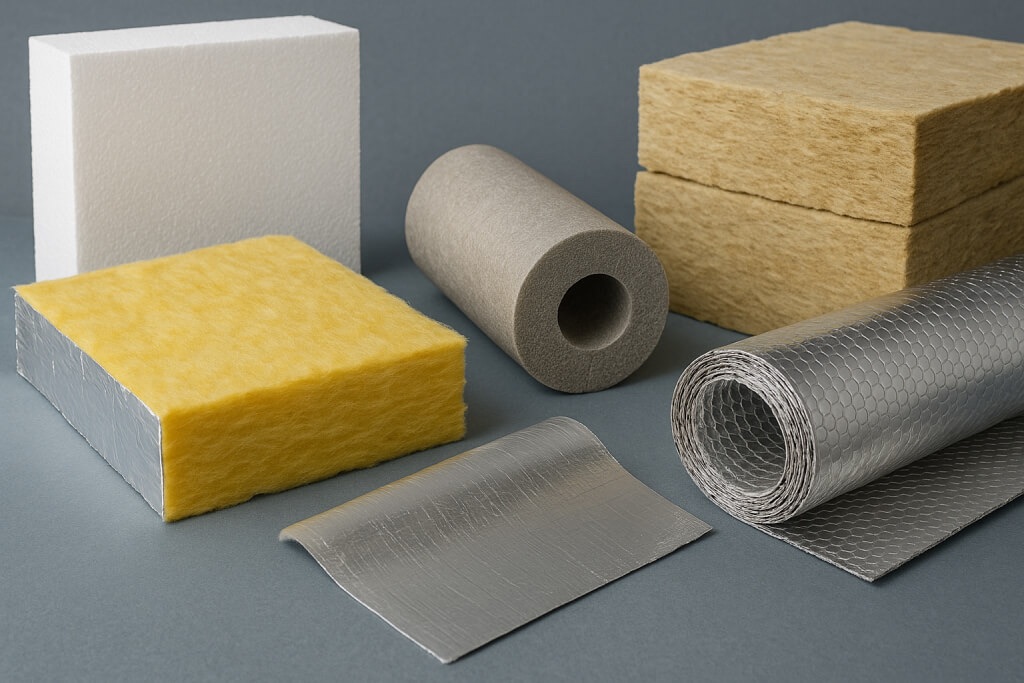
Advancements in insulation materials and designs are transforming cold storage efficiency, focusing on higher thermal performance, sustainability, and space optimization. Traditional polyurethane (PUR) foams are being enhanced with microfoam technology, reducing pore sizes by up to 40% to improve insulation capability by 10%, allowing for thinner panels without compromising energy savings.
High-performance alternatives like extruded polystyrene (XPS) offer superior moisture resistance and durability, maintaining R-values over decades, while vacuum insulated panels (VIPs) provide 5-10 times the efficiency of conventional materials in ultra-thin profiles—ideal for space-constrained facilities. Aerogels and cryogels deliver exceptional low-conductivity insulation for extreme low-temperature applications, and phase change materials (PCMs) absorb or release heat during phase transitions, enabling multi-zone temperature control in a single facility.
Sustainability is a growing focus, with innovations like nanomaterial-based coatings that reflect solar heat and emit mid-infrared radiation, reducing energy needs in hot climates. Recycled materials and hybrid systems, such as mineral wool combined with rigid foams, lower environmental impact while enhancing fire resistance. Structural integrations like FUSIONFRAME embed cores in PUR foam for better durability, and QuadCore hybrid cores represent next-generation self-blended insulation for superior thermal defense. These developments not only cut energy use but also support eco-friendly practices, such as solar-powered systems and smart energy management.

Recommended Insulation Thicknesses for Different Materials and Temperatures
Recommended thicknesses vary by material, temperature range, and regional standards, aiming to balance thermal performance with cost. Globally, for sandwich panels (often with PUR/PIR cores), guidelines suggest:
- Chiller rooms (0°C to +5°C): 75-100 mm
- Freezer rooms (-18°C and below): 100-150 mm
- Ultra-freezing tunnels (-40°C): 150-200 mm
These ensure adequate R-values (e.g., R-30 minimum for roofs in moderate climates). Materials like polyisocyanurate (polyiso) are favored for high R-values in thinner profiles, while expanded polystyrene (EPS) and rockwool suit cost-sensitive applications.
Indian Standards (IS 661:2000)
In India, per IS 661:2000 (assuming 40°C ambient and 50% RH), minimum wall thicknesses are specified for various materials, with multi-layering required for thicknesses over 50 mm to stagger joints and enhance integrity. Roofs and floors may need thicker insulation based on U-values (heat transmission coefficients). Vapour barriers are mandatory on the warm side to prevent moisture ingress.
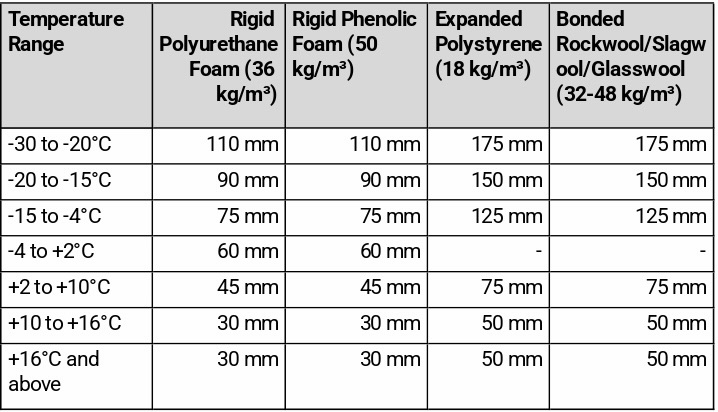
Note: For floors, use rigid materials with compressive strength; add protective layers like asphalt for waterproofing. In other regions like Jordan, OIT for EPS at -30°C ranges from 100-150 mm depending on climate zone, emphasizing local adaptation.
NHB Standards
The National Horticulture Board (NHB) in India provides technical standards (e.g., NHB-CS-Type 01) for cold storages, particularly for horticultural produce, recommending insulation designs for temperatures around -4°C to +2°C to minimize heat load. These align closely with IS 661:2000 and specify minimum thicknesses based on U-values (e.g., 0.24 W/m²K for external walls). NHB emphasizes materials like PUF (100-150 mm for walls), XPS for floors, and vapor barriers. For multi-commodity cold storages, radiant barriers are optional for energy savings, but minimum thicknesses must be maintained.

NHB also proposes revised thicknesses for broader temperature ranges in some documents, such as 120 mm PUF for exposed walls at -30°C to -20°C.
NCCD Recommendations
The National Centre for Cold-chain Development (NCCD) offers engineering guidelines for cold chain infrastructure in India, promoting energy-efficient designs with insulation thicknesses from 60 mm to 200 mm based on application, commodity, and climate. NCCD recommends PUF at 40 kg/m³ density for walls/ceilings (e.g., 100-150 mm), XPS for floors (preferring it over EPS for better compressive strength), and multi-layer installation with vapor barriers. For solar-integrated or transit cold rooms, specifics include 100 mm PUF for 4°C applications and up to 120 mm for -5°C. NCCD emphasizes U-values, safety, and alignment with standards like IS 661, ensuring minimal heat transmission for sustainability. 9 10 12 17
For example, in cold storage Type II (multi-commodity), NCCD suggests calculating thicknesses to achieve U-values like 0.24-0.58 W/m²K, similar to NHB, with floor insulation in two layers (e.g., 75-100 mm Trimix finish).
Conclusion
Optimizing insulation thickness in cold storage directly enhances energy efficiency by curbing heat infiltration and reducing operational costs, though it requires careful consideration of diminishing returns and site-specific factors. Innovations like VIPs, PCMs, and sustainable foams are paving the way for more efficient, eco-friendly solutions. By adhering to recommended thicknesses tailored to materials and temperatures—such as those in IS 661, NHB standards for horticultural applications, and NCCD guidelines for broader cold chain infrastructure—facilities can achieve significant savings while maintaining reliability. Consulting these standards and conducting LCC analyses ensures the best outcomes for long-term performance.