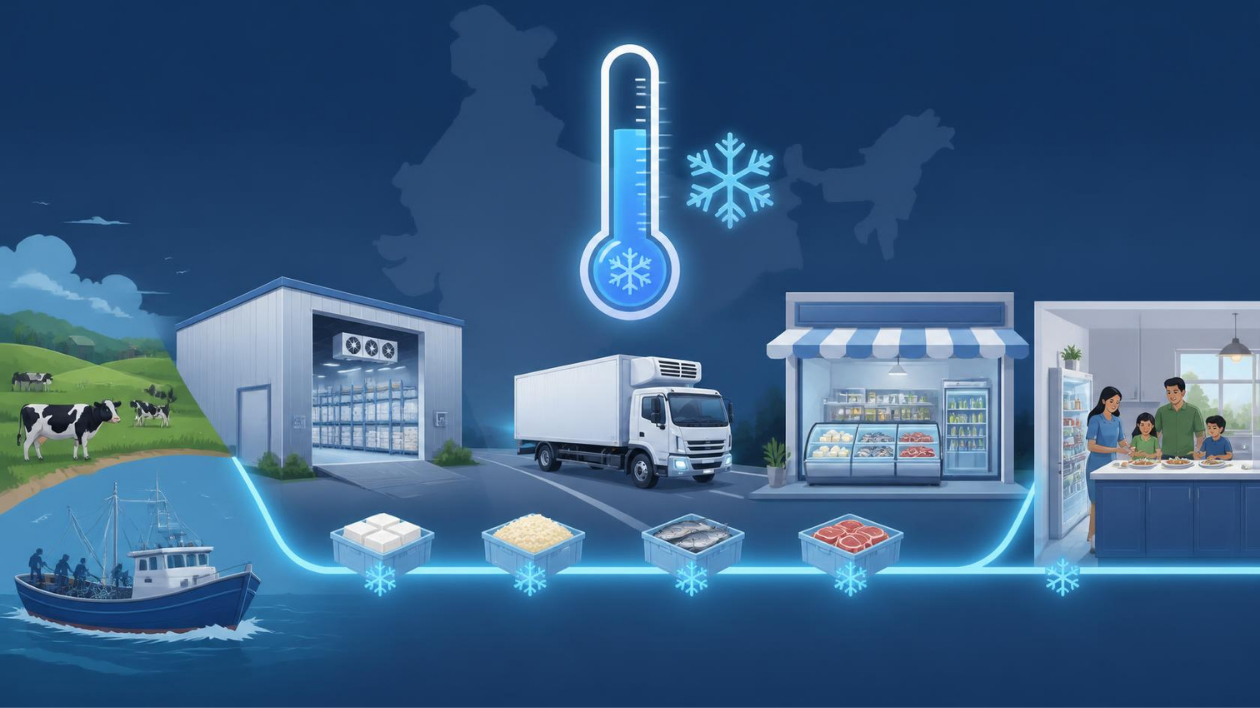
On 15 October 2026, the Food Safety and Standards Authority of India (FSSAI) put every food business handling khoa, paneer, meat and fish on notice: the cold chain is no longer optional, from source to consumer. The advisory (F. No. RCD-15001/11/2021-Regulatory-FSSAI), issued by the Regulatory Compliance Division, directs Food Business Operators (FBOs) to maintain prescribed temperatures through every stage of storage and transport, and asks enforcement officers to step up checks.
For an industry where a dairy sweet can travel in a gunny bag on an open truck, this is a clear signal. Temperature control is being treated as a licensing obligation, not a best practice.
What the advisory says
The advisory rests on Schedule 4 of the Food Safety and Standards (Licensing and Registration of Food Businesses) Regulations, 2011. Schedule 4 sets the hygienic and sanitary conditions attached to every FSSAI licence and registration.
FSSAI notes it has received reports that perishables are at times not handled, stored or transported at appropriate temperatures. It reminds FBOs that the licence conditions already require the prescribed temperature to be held across the whole supply chain: procurement, chilling, storage, transport, distribution and delivery to the end consumer. Temperature abuse, the advisory states, is itself non-compliance with Schedule 4.
The directions apply to everyone who manufactures, packs, stores, transports, distributes or sells these commodities:
- Clean vehicles. Transport only in clean, covered and hygienic vehicles suitable for food.
- Temperature control. Maintain prescribed temperatures throughout storage and transport.
- Food-grade packaging. Use food-grade primary and suitable secondary packaging; avoid gunny bags and other non-food-grade coverings.
- Physical protection. Guard against dust, moisture, pests, physical damage and cross-contamination during storage, loading, unloading and transit.
- Records and traceability. Keep consignment records and produce invoices or other documents when the competent authority asks.
Why these foods are singled out
Khoa, paneer, meat and fish share three traits: high moisture, high protein and little natural protection against microbes. Held warm, bacteria multiply quickly, and the damage is often invisible until the product is consumed.
The risk is sharpest at the hand-offs. A product may leave a chilled plant in good condition, then wait on a loading dock, ride in an uninsulated vehicle, and sit in a market stall before it reaches a kitchen. Each break adds up, and no later chilling reverses it.
The festive season makes this timely. Demand for khoa and paneer peaks around Diwali, and so do adulteration and spoilage complaints. Long-distance movement of dairy and seafood into cities also rises, stretching informal transport links further.
Enforcement: inspections on the road, not just at the plant
The advisory goes to the Commissioners of Food Safety of all States and UTs, all FSSAI Regional Directors, and the Railway Board. They are asked to have Licensing Authorities and Food Safety Officers keep strict vigilance during both inspections and transportation checks.
Where they find non-compliance, officers may act under the Food Safety and Standards Act, 2006, including seizure and destruction of the goods. For a trader, that means a single warm consignment can be a total loss, before any penalty proceedings.
Two details stand out. Including Indian Railways brings rail-borne perishables, such as fish and dairy moved in parcel vans, squarely into scope. And FSSAI's social media and website teams are copied for wide circulation, so few operators will be able to claim they were unaware.
A practical checklist for food businesses
Compliance comes down to being able to show, at any point, that the product stayed cold, clean and traceable.
- Know your temperature. Write down the required range for each product (chilled or frozen) and make it part of every purchase order and transport contract.
- Use reefer or insulated vehicles. Check that units pre-cool before loading and that doors stay shut in transit.
- Log temperatures continuously. Data loggers or GPS-linked sensors give a record an inspector can trust; manual entries are a minimum.
- Shorten the dock. Load and unload in chilled or covered areas, and limit the minutes product spends outside temperature.
- Replace gunny bags. Move to food-grade crates, liners and cartons.
- Segregate. Keep raw meat and fish away from dairy and ready-to-eat items in storage and in vehicles.
- Keep paper with the load. Invoices, batch details and temperature records should travel with each consignment.
- Check your partners. Every warehouse and transporter in the chain should hold a valid FSSAI licence and meet Schedule 4.
The bigger picture: from compliance to confidence
The advisory does not create new law. It restates what Schedule 4 has required since 2011 and tells enforcement to take it seriously. What changes is the cost of ignoring it.
For many small and mid-sized FBOs, owning reefers and cold rooms in every market is not practical. Organised cold chain partners close that gap: temperature-controlled warehousing, monitored transport and the records that prove it. At Indicold, our facilities across Maharashtra, Gujarat, Tamil Nadu, Karnataka and Uttar Pradesh are built for exactly this kind of continuity.
The businesses that move first will do more than avoid seizures. They will cut spoilage, protect their brands, and earn the trust of consumers who increasingly ask where their food has been. That is the real outcome FSSAI is pointing to: safer food, held at the right temperature, every step of the way.
Source: FSSAI Advisory F. No. RCD-15001/11/2021-Regulatory-FSSAI, dated 15 October 2026.