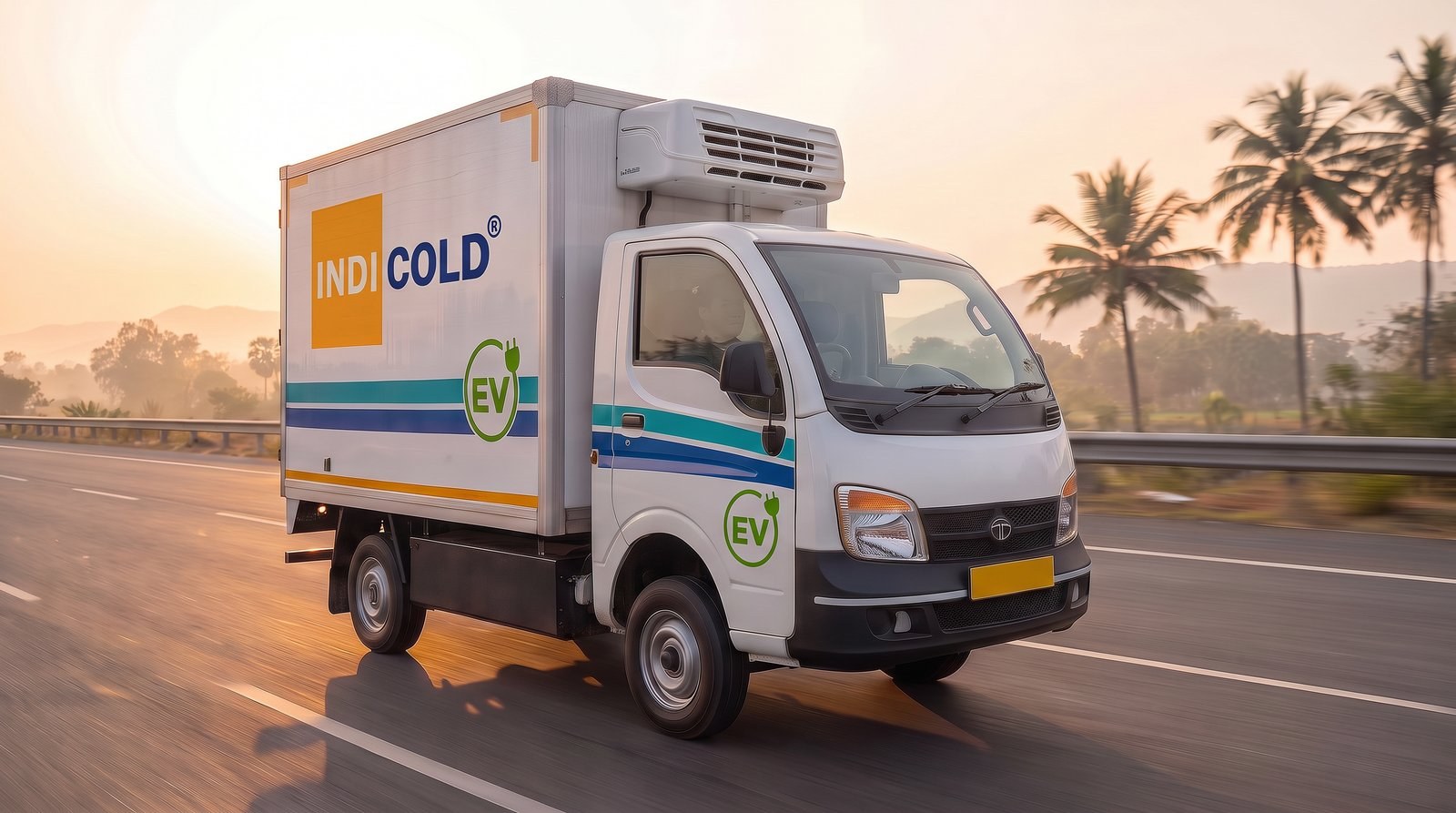
Electric refrigerated trucks, charged by solar power at our Palwal warehouse, now carry temperature-controlled loads across Delhi NCR — our step towards cleaner air and a more sustainable cold chain for the region.
At a glance
- Fleet: electric refrigerated trucks
- Where: Indicold’s transport operations across Delhi NCR
- Charging: at our Palwal warehouse, powered by its 100 kW solar plant
- Proven first: tested on real routes before we committed
- Compliance: electric goods vehicles are permitted into Delhi under CAQM’s entry rules, which tightened again on 1 November 2026
- Emissions: zero at the tailpipe — and no diesel engine running the cooling unit
Clearing the air in NCR
Every winter, Delhi NCR’s air quality slides into the “poor” and “severe” bands, and road transport is one of the contributors that the region can actually change. The Commission for Air Quality Management has said plainly that older goods vehicles carry a much higher emission load as they move through NCR and into Delhi.
Cold chain trucks add a second source on top of the engine: the diesel-powered cooling unit that runs for hours, often while the truck sits at a loading dock or in traffic. Replacing them with electric reefers removes both.
We charge these trucks with solar power at our Palwal warehouse, so the energy that keeps food cold on the road comes from the sun. We believe this is how cold chain helps turn NCR’s air around — one route at a time, towards a cleaner and more sustainable future.
Why now: Delhi’s door has narrowed for goods vehicles
The Commission for Air Quality Management (CAQM) has been steadily tightening which trucks can enter Delhi. Under its Direction No. 88 (issued April 2025 and amended in October 2025), light, medium and heavy goods vehicles registered outside Delhi may enter the capital only if they are BS-VI, CNG, LNG or electric.
The rollout came in two steps:
- From 1 November 2025, BS-III and older goods vehicles from outside Delhi were barred.
- From 1 November 2026, the one-year transition for BS-IV trucks ended. That transition existed largely because a big share of trucks entering Delhi carry essential supplies — food included. It is now over.
On top of this, the Graded Response Action Plan (GRAP) adds further curbs on truck entry when air quality turns severe — and electric trucks remain among those allowed through even at the strictest stage.
For a cold chain operator, the message is clear. Chilled and frozen food cannot wait at a border check post. The vehicles carrying it need to be welcome on every road into the city, in every season, including the winter months when restrictions bite hardest.
Why electric — and not just a newer diesel
A BS-VI diesel reefer would also meet today’s rules. We chose electric for reasons that go beyond the current notification:
- The cooling runs clean too. On an electric reefer, the refrigeration draws from the battery instead of a diesel engine. No idling exhaust at customer docks.
- Quieter city deliveries. Early-morning and late-night drops in residential and market areas are far less intrusive.
- Ready for what comes next. Policy across NCR is moving firmly towards cleaner commercial fleets. An electric fleet puts us ahead of that curve rather than chasing it.
Tested before we committed
We did not switch to electric on faith. Before putting these trucks into service, our team ran trials on real NCR routes to check that electric reefers could match the standard our customers expect from us. The results gave us the confidence to move ahead.
We ran two separate trials, in July and August 2026, on live cold chain runs out of Palwal and Faridabad. The trucks carried frozen goods, ice cream included, through Gurugram, Noida, Greater Noida and South Delhi markets such as Lajpat Nagar, Malviya Nagar and Vasant Kunj, covering just over 600 km in four days.
Solar charging at Palwal
The fleet is charged at our Palwal warehouse, home to a 100 kW solar installation. Each truck starts its day at the same dock where it is loaded — product in, charge topped up, out on the road.
Owning the charging point matters. Our deliveries do not depend on finding a free public charger, our uptime is predictable, and the warehouse, the solar plant and the fleet work as one clean system. Every kilometre these trucks drive on Palwal’s solar power is a kilometre of cold chain with no fuel burned at all.
Same service, cleaner wheels
For our customers, nothing about the service changes — the same temperature control, the same reliability, the same team. What changes is what comes out of the exhaust: nothing.
This is not a side project. It is our existing NCR transport operation, moving from diesel to electric.
Open about the results
We would rather show numbers than make claims. As the fleet runs, we will keep sharing what we see — range, uptime and emissions avoided — and use that data to take electric reefers across more of our NCR routes, and then to the other cities where we operate.
Move your cold chain with us
If you ship chilled or frozen goods into or around Delhi NCR and want a compliant, lower-emission option, we would like to hear from you. Get in touch with Indicold or visit www.indicold.com.