
India has built most of the cold storage it needs, but not the chain around it. Budget 2027 is the moment to stop funding warehouses in isolation and start funding the links between them: power, tax, finance, transport and data.
The Union Budget for 2027-28 arrives at an unusual moment for the cold chain. The main central scheme for cold chain infrastructure, Pradhan Mantri Kisan Sampada Yojana, was funded only through 2025-26 (Business Standard). In October 2026, FSSAI told every business that stores or moves perishable food to keep it under controlled temperatures with traceable records (Maritime Gateway). And quick commerce, exports and organised retail are pushing demand towards modern, multi-temperature capacity that the old potato-store model was never designed to provide.
Ten asks for Budget 2027, in brief
- 1. Power: treat cold storage as essential infrastructure in electricity tariffs and duties, and make clean power easier to buy.
- 2. GST input credit: let cold chain operators claim input tax credit on insulated cold store structures in its entirety.
- 3. Direct tax: restore an investment-linked incentive for modern cold chain that works under the lower corporate tax regime.
- 4. Finance: long-tenor, infrastructure-grade debt for cold chain, and wider access to the Agriculture Infrastructure Fund.
- 5. A new scheme cycle: renew central cold chain support for 2026-31, refocused from storage capacity to the missing links.
- 6. Modern capacity: top-up support for automation, multi-temperature hubs and natural refrigerants.
- 7. Reefers: make refrigerated trucks and electric refrigeration units a clear priority in clean-freight incentives.
- 8. Data and standards: one digital temperature record per consignment, built into national logistics platforms.
- 9. Skills: a national programme for refrigeration technicians and cold chain operators.
- 10. Exports: cold chain at ports, rail terminals and airports, linked to frozen food and seafood export goals.
Plus two smaller fixes that cost the Centre little but help operators grow:
- Stamp duty: lower or waive stamp duty on long leases of cold storage assets taken by cold chain operators.
- Electricity deposits: ease the cash security deposit for power connections on long-leased cold chain facilities.
This article sets out the evidence behind each ask, what it would cost, and where the trade-offs lie.
Where India’s cold chain stands
On paper, India has a lot of cold storage. Capacity reached about 40.2 million tonnes across 8,815 facilities by June 2025. But roughly three-quarters of it is used for potatoes, and more than half sits in just two states, Uttar Pradesh and West Bengal (Grant Thornton Bharat).
Measured against the targets in the India Cooling Action Plan, the picture is lopsided:
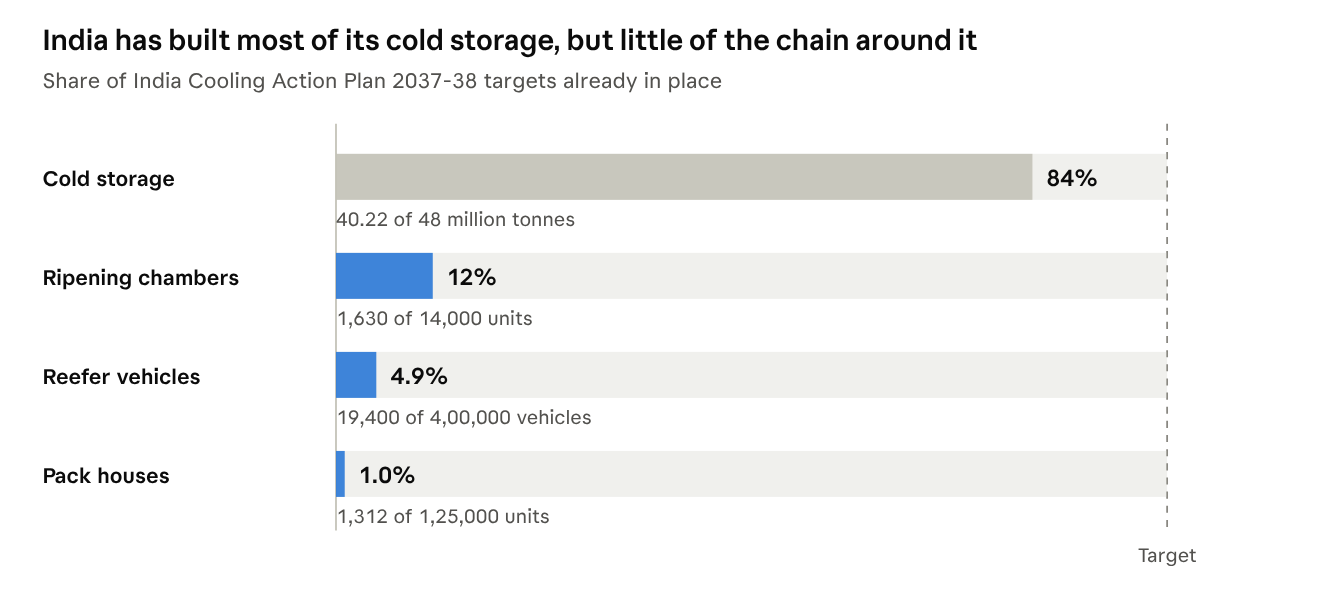
This is not a new finding. A decade ago, the national cold chain gap study by NCCD and NABCONS concluded that India’s problem was less about storage capacity and more about the links around it: pack houses near farms, refrigerated transport and onward connectivity to consumers (India Blooms). Ten years on, those links are still the weakest part of the chain.
The cost of the gaps is large. A government-commissioned NABCONS study put annual post-harvest losses at about ₹1.53 lakh crore (Dataful). Grant Thornton estimates that missing distribution infrastructure could cost around ₹1.75 lakh crore cumulatively by 2037-38 (Grant Thornton Bharat).
What policy has done so far
India does not lack cold chain schemes. The problem is that they are spread across ministries, sized for a different era, and mostly measure capacity built rather than food delivered safely.
- PMKSY and its cold chain component. The Pradhan Mantri Kisan Sampada Yojana, run by the Ministry of Food Processing Industries, includes the Integrated Cold Chain and Value Addition Infrastructure scheme. In July 2025, the Cabinet raised PMKSY’s outlay to ₹6,520 crore for the 15th Finance Commission cycle ending 2025-26, with about ₹1,000 crore earmarked for 50 food irradiation units and 100 food testing labs (Business Standard).
- Horticulture and farm-gate support. The Mission for Integrated Development of Horticulture supports cold storage under its cost norms, and the Agriculture Infrastructure Fund had mobilised over ₹1.23 lakh crore and supported more than 2,700 cold storage projects by November 2025 (OkCredit, citing the Economic Survey 2025-26).
- Budget 2026-27. Last February’s budget raised public capital expenditure to ₹12.2 lakh crore and backed freight corridors, waterways, fisheries value chains and seafood processing inputs, but industry coverage found no dedicated rupee allocation for cold chain infrastructure (Nuffoods Spectrum).
- Clean freight. Under PM E-DRIVE, the government launched incentives of up to ₹9.6 lakh per electric truck for around 5,600 trucks in the N2 and N3 categories (Inc42).
The result is a set of useful but disconnected tools. Budget 2027 is the right moment to connect them, because the main scheme cycle has ended and a new one has to be designed anyway.
Ask 1: Make power affordable and predictable
The problem. Electricity is the single largest operating cost of a cold store. Snowman Logistics’ CEO has put it at around half of operating costs, with little room to cut it without risking temperature (Logistics Insider). Yet tariffs and duties vary widely by state, and cold storage is often billed as commercial load rather than as essential infrastructure. In Gujarat, for example, cold storage associations pointed out in 2019 that they paid electricity duty of 20 to 25% against 15% for industry, despite logistics having been given industry status (DNA India).
Electricity tariffs are set by states, so the Union Budget cannot fix this alone. But it can push in the right direction.
What Budget 2027 could do.
- A central nudge on tariff category. Use the Centre’s tariff policy guidance and incentive-linked transfers to encourage states to bill temperature-controlled storage and pack houses at industrial or agricultural rates, and to align electricity duty with industry.
- Easier clean power. Simplify green energy open access and banking for cold chain facilities, so operators can contract solar and wind directly at predictable prices.
- Solar plus storage on cold stores. Extend capital support or viability funding to rooftop solar and thermal or battery storage at cold chain facilities. Cold stores are ideal for this: they have large roofs and a load that can be shifted by pre-cooling during the day.
- Efficiency incentives. Link part of any capital support to measured energy performance, such as kilowatt-hours per pallet or per tonne stored, rather than to equipment purchased.
Why it matters beyond the industry. Every rupee saved on power is a rupee that can flow into lower storage rates for farmers and food brands, or into the next facility.
Asks 2 and 3: Fix the tax treatment of cold chain investment
Ask 2: Input tax credit on cold store structures
The problem. A modern cold store is closer to a machine than a building. Its insulated panels, vapour barriers, insulated floors and racking exist only to hold a temperature. Yet under GST, credit on goods and services used to construct immovable property on one’s own account is blocked, with an exception only for plant and machinery. After the Supreme Court’s Safari Retreats judgment left room for a functionality test, the Finance Act 2025 amended the law retrospectively to close that route for buildings and civil structures (TaxGuru).
Credit on plant and machinery, such as refrigeration plant, compressors, evaporators and electrical systems, remains available, and operators claim it routinely. The gap is the structure: the building, foundations and insulated floor, and often the insulated envelope and pre-engineered shell, where classification is contested. GST paid on that civil and structural share, a large part of a cold store’s project cost, becomes a permanent cost rather than a pass-through, even though the storage services the facility later sells are taxed at 18% (TaxClue).
What Budget 2027 could do. Propose, through the GST Council, a narrowly defined carve-out that treats the insulated envelope of a temperature-controlled facility (insulated panels, insulated floors and vapour barriers) as plant and machinery for input tax credit, and so settles today’s classification disputes, limited to facilities that supply taxable cold chain services. A tight definition keeps the revenue cost contained and avoids reopening the wider debate on commercial buildings.
Ask 3: An investment incentive that works under today’s tax regime
The problem. India’s income tax law has long offered an investment-linked deduction for setting up and operating a cold chain facility. But companies that opt for the lower concessional corporate tax rate generally give up such deductions, which leaves many modern operators with no specific incentive for very capital-heavy assets.
What Budget 2027 could do.
- Allow accelerated depreciation on refrigeration plant, insulated structures, automation and reefer equipment that remains available under the concessional regime.
- Or offer a time-bound investment allowance for new multi-temperature, automated or natural-refrigerant capacity.
- Clarify that integrated cold chain hubs, not only farm-gate stores, qualify.
Note on rates. GST on goods transport now runs at 5% without input credit or 18% with it, following the September 2025 rate changes (Lakshmikumaran & Sridharan). Reefer operators should model which option suits them; the main structural ask is the credit on cold store construction above.
This section describes policy options, not tax advice. Readers should take professional advice on their own position.
Asks 4 and 5: Patient capital and a refocused scheme
Ask 4: Infrastructure-grade finance
The problem. A modern cold store pays back over many years, but much of the debt available to the sector is short-tenor and priced like working capital. Frozen cold storage costs roughly ₹3,200 to ₹4,000 per square foot to build before land (Mordor Intelligence), so the cost of capital decides whether a project is viable.
What Budget 2027 could do.
- Longer tenors. Direct infrastructure lenders such as NaBFID and NABARD to offer 12 to 15-year loans for cold chain projects, with repayment moratoriums matched to construction and ramp-up.
- Wider AIF scope. Extend Agriculture Infrastructure Fund eligibility and interest subvention beyond farm-gate assets to city-level, multi-commodity distribution hubs that serve farmers, processors and retail together.
- Credit guarantees. A partial credit guarantee for first-time modern cold chain projects in under-served regions, where lenders are most cautious.
- Asset recycling. Support for investment trusts and long-term institutional capital in completed cold chain assets, so developers can recycle equity into new capacity.
Ask 5: A new scheme cycle, built around the links
The problem. Past schemes funded what was easiest to count: tonnes of storage. As the chart above shows, that is the part of the chain closest to target. Grant Thornton recommends a single application route, common technical standards and outcome-linked support across ministries (Grant Thornton Bharat).
What Budget 2027 could do. Announce the successor to the cold chain components of PMKSY for 2026-31 with:
- Funding weighted to the missing links: pack houses and pre-cooling near farms, ripening chambers, reefers and city distribution hubs.
- One window for central cold chain support, replacing parallel applications to different ministries.
- Outcome-linked tranches, with part of the support released only when a facility shows sustained utilisation and verified temperature performance.
- Regional balance, with higher support in the North-East, the South and other regions that are under-served today.
Ask 6: Back modern, multi-temperature and low-carbon capacity
The problem. Demand is shifting from single-commodity potato stores to facilities that hold frozen, chilled and ambient goods together, serve quick commerce and retail, and keep digital proof of temperature. Mordor Intelligence notes that retail chains, quick-service restaurants and pharmaceutical companies increasingly need all three zones on one site (Mordor Intelligence). These facilities cost more to build, especially when automated.
What Budget 2027 could do.
- Top-up support for automation. Additional capital support for automated storage and retrieval, which cuts the time product and people spend in the cold, improves accuracy, and uses space and energy more efficiently.
- Natural refrigerants. Preferential support for ammonia and CO₂ systems over high-global-warming refrigerants, in line with India’s commitments under the Kigali Amendment and the India Cooling Action Plan.
- Efficient temperature standards. Support pilots, with food-safety regulators, on whether some frozen products can be held safely at slightly warmer set points, as the international Move to −15 °C initiative proposes, cutting energy use without compromising quality.
- R&D. A weighted deduction or grant for cold chain R&D, from warehouse robotics to insulation and refrigeration control, so more of this technology is designed and built in India.
Ask 7: Put refrigerated transport at the centre
The problem. Refrigerated vehicles are the thinnest link in the chain: about 19,400 against an India Cooling Action Plan target of 4,00,000 (Grant Thornton Bharat). Many small loads still travel in ordinary trucks or under ice, because a reefer for a part load is hard to find or too expensive. Meanwhile, the refrigeration unit on a diesel reefer burns fuel even when the truck is parked.
What Budget 2027 could do.
- Clean-freight incentives that fit reefers. Make clear that refrigerated N2 and N3 electric trucks, including the refrigerated body and electric transport refrigeration unit, qualify for PM E-DRIVE support, with a reefer-specific top-up that reflects their higher cost (Inc42).
- Electric and hybrid refrigeration units. Support for retrofitting electric or hybrid refrigeration units on existing trucks, and shore-power points at cold stores so parked reefers can plug in.
- Pooled and shared reefers. Support for platforms and operators that consolidate small loads from farmers, processors and small brands, as Grant Thornton recommends for the first mile (Grant Thornton Bharat).
- Charging where reefers go. Prioritise fast charging at cold chain hubs, logistics parks and highway freight stops in public charging funding.
Asks 8, 9 and 10: Data, skills and exports
Ask 8: One temperature record per consignment
The problem. FSSAI now expects perishable food to be kept under controlled temperatures throughout the chain, with traceability records available on request (Maritime Gateway). In practice, records are scattered across clipboards, sensor vendors and spreadsheets, and inspectors keep finding gaps (NewKerala).
What Budget 2027 could do. Fund a common, machine-readable temperature record that travels with each batch, built into the existing Unified Logistics Interface Platform rather than a new system, as Grant Thornton proposes (Grant Thornton Bharat). Pair it with a small grant for MSME operators to install compliant sensors and loggers. The prize is a chain where a regulator, a buyer or an insurer can check any consignment in minutes.
Ask 9: Skills for a technical industry
The problem. Modern cold chain needs refrigeration technicians, ammonia-safety specialists, automation engineers and trained warehouse staff who can work safely at −25 °C. These skills are scarce outside a few clusters.
What Budget 2027 could do. Fund a national cold chain skills programme through existing skilling missions, with industry-certified courses, apprenticeships at operating facilities, and safety certification for ammonia and CO₂ systems.
Ask 10: Cold chain for exports
The problem. India’s frozen food, seafood and fresh produce exporters depend on reliable cold chain from farm to port. Industry leaders responding to last year’s budget stressed the need for resilient cold chains, including cold storage, from farms to seaports (Nuffoods Spectrum).
What Budget 2027 could do. Build or upgrade temperature-controlled facilities at major ports, air cargo terminals and inland container depots; support refrigerated rail services on dedicated freight corridors; and link cold chain support to export clusters for seafood, frozen vegetables and fruit.
Asks 11 and 12: Smaller fixes that help operators grow
A growing share of India’s new cold chain capacity is not owned by the company that runs it. Developers and investors build the facility, and a specialist cold chain operator runs it on a long lease, often 15 to 30 years. The model lets capital and operating expertise each do what they do best, and it is how cold chain networks scale quickly. Two small frictions make it harder than it needs to be. Indicold has raised both repeatedly, and neither needs a large outlay.
Ask 11: Lower or waive stamp duty on long cold chain leases
The problem. Stamp duty on a lease is a state levy, and in many states the longer the lease, the more it is taxed like a sale: duty is worked out on the total rent over the term, or on the property’s value, and paid upfront at registration. For a 20- or 30-year lease on a large facility, that is a substantial cash outlay before the operator has stored a single pallet. It also pushes parties towards shorter leases, which make long-term investment in automation and equipment harder to justify.
States already know the lever works. Maharashtra, for example, reduced stamp duty on long leases of 29 years or more for immovable property in Mumbai in 2020 (CSIS Engaging Indian States).
What Budget 2027 could do.
- A model concession. Propose that states exempt, or cap at a nominal amount, stamp duty on registered long leases of temperature-controlled facilities taken by cold chain operators.
- Reform-linked incentives. Encourage states to adopt it through the reform-linked component of the Centre’s capital-expenditure support to states.
- Lead by example. Apply the concession first in the Union Territories.
- Keep it targeted. Limit it to facilities that stay in active cold chain use, with temperature monitoring in place, and claw it back if the asset is converted to another use.
Why it costs little. The revenue forgone is small against total stamp collections, while the facilities it helps bring on stream generate GST, employment and electricity demand for decades.
Ask 12: Ease electricity security deposits on long-leased cold chain assets
The problem. Distribution companies require a cash security deposit before they energise or transfer a connection. For high-tension consumers this is typically about two months’ estimated bill; Maharashtra’s distribution company, for example, sets it at twice the estimated monthly bill (MSEDCL). A cold store runs around the clock, so for a large facility that deposit can run to tens of lakhs of rupees, locked up for the life of the connection. When an operator takes over a facility on a long lease, it may have to place a fresh deposit even though the building, the load and the connection are unchanged.
What Budget 2027 could do. Electricity supply codes are set by state regulators, so the Centre’s role is to guide and encourage. Through the Ministry of Power’s consumer rules and advisories to state commissions, it could promote:
- Guarantees instead of cash. Bank guarantees or insurance surety bonds accepted in place of a cash deposit.
- Transfer, not duplication. An existing deposit carried over to the incoming operator on a registered long lease, rather than a second deposit on the same connection.
- Lower deposits for a good record. A reduced deposit, or prepaid or advance billing, for operators with a long registered lease and a clean payment history.
Why it matters. Every rupee released from deposits is working capital an operator can put into the next chamber, reefer or facility.
Who decides, what it costs, and the case against
Not every ask is the Finance Minister’s to grant, and not every one is expensive. The table below gives our assessment of where each decision sits and its rough fiscal weight.
The honest case against. A credible wishlist should answer its critics:
- Subsidies have built the wrong capacity before. Much of India’s storage went into single-commodity potato stores, and some regions have spare space: Gujarat’s cold storage association reported about 28% of potato capacity unused in 2019 (DNA India). That is why support should be tied to the missing links and to measured outcomes, not to tonnes built.
- Tax carve-outs invite copycats. A GST credit for cold stores could prompt similar demands from other sectors. A narrow, technical definition and a clear public-interest rationale, food safety and food loss, help keep it contained.
- Power is a state matter, and discoms are stretched. Lower tariffs for one group can mean higher tariffs for another. Clean power, efficiency and storage offer savings without shifting the bill to other consumers.
- Fiscal space is limited. Several asks cost little: long-tenor finance, digital records and skills mainly need direction, not large outlays. They could come first.
The bottom line
India’s next cold chain decade should be measured by a simple test: how much of what is grown, caught and made reaches its buyer at the right temperature. Grant Thornton proposes exactly that metric for 2047 (Grant Thornton Bharat). Budget 2027 can start moving the country towards it by funding the links rather than the boxes, making power and tax work for long-life infrastructure, and turning temperature records from paperwork into shared, trusted data.
At Indicold, we build and operate automated, multi-temperature cold chain infrastructure across India, and we see these gaps every day. We would welcome the chance to share data and practical experience with policymakers as the next scheme cycle is designed. Get in touch.
Sources
- Grant Thornton Bharat: India’s cold chain infrastructure, from storage to a chain
- India Blooms: All India Cold-chain Capacity Assessment (NCCD and NABCONS)
- Dataful: What food loss reveals about India’s supply chains (NABCONS 2022)
- Business Standard: Cabinet raises PMKSY outlay to ₹6,520 crore
- Nuffoods Spectrum: Food sector hails Budget 2026-27
- OkCredit: Cold storage business costs, citing the Economic Survey 2025-26
- Inc42: PM E-DRIVE incentive scheme for e-trucks
- Maritime Gateway: FSSAI directs strict temperature control for perishable foods
- NewKerala: Maharashtra FDA suspends 14 food licences
- Logistics Insider: Issues plaguing cold chain infrastructure
- DNA India: Gujarat cold storages demand incentives and lower power duties (2019)
- TaxGuru: Input tax credit on construction after Safari Retreats
- TaxClue: GST on cold storage
- Lakshmikumaran & Sridharan: GST rate changes and the logistics sector
- Mordor Intelligence: India cold storage market
- CSIS Engaging Indian States: Maharashtra reduces stamp duty on long leases in Mumbai (2020)
- MSEDCL: Security deposit estimation