Quick commerce has made frozen and chilled food an impulse buy. The ten-minute promise to the customer now rests on a much harder promise upstream: that the product never left its temperature band on the way to the dark store.
Key findings
- Over 9 million orders a day. India’s quick-commerce platforms crossed this mark in August 2026, with Blinkit, Zepto and Instamart handling roughly four in five of them.
- Orders nearly quadrupled in two years. The top three platforms went from about 511 million orders in FY24 to about 1.97 billion in FY26.
- 5,026 dark stores, up 48% in a year. That is the combined Blinkit, Instamart and Zepto network in May 2026, against 3,405 a year earlier.
- Regulators are now checking freezers. In August 2026 the Maharashtra FDA inspected 86 quick-commerce facilities and suspended 14 food licences, citing inadequate temperature control among other lapses.
- Small packs suffer most from warm-ups. Lab studies show even one cycle from −18 °C to −12 °C and back pushes ice-cream crystals past the size people can taste.
The quick-commerce boom
Quick commerce is now the fastest-growing slice of Indian retail. Brokerage Equirus projects the market at about ₹1.08 lakh crore in 2026, growing 40% a year, more than twice the pace of digital commerce overall (Apparel Resources).

The order count tells the story best. Blinkit, Zepto and Instamart together processed close to two billion orders in FY26 (April 2025 to March 2026), up from about half a billion two years earlier, according to Zepto’s updated draft prospectus (Apparel Resources). By August 2026 the industry had crossed nine million orders a day, with Blinkit at 3.4 to 3.6 million, Zepto at 2.4 to 2.6 million and Instamart at 1.3 to 1.45 million (NewsBytes).
The network behind those orders is growing just as fast. The five largest operators added close to 900 dark stores between April and July 2026 alone (Address Advisors, citing The Times of India):
| Platform | Dark stores, Apr 2026 | Dark stores, Jul 2026 | Added |
|---|---|---|---|
| Blinkit | 2,222 | 2,511 | 289 |
| Zepto | 1,255 | 1,345 | 90 |
| Flipkart Minutes | 741 | 1,003 | 262 |
Every one of these dark stores is, in effect, a small cold room in a residential neighbourhood. Each needs frequent, small replenishments of frozen and chilled stock, and each is a new point where temperature can slip.
Why frozen and chilled lead the basket
Frozen and chilled products are among quick commerce’s strongest categories, because they are bought on impulse and for immediate use. Hindustan Unilever’s leadership has said convenience categories such as food and ice cream do especially well on the channel, and that quick commerce is a very significant channel for its ice cream (HUL).

The underlying categories are growing fast as well. IMARC values India’s frozen foods market at about ₹21,659 crore in 2025 and expects it to reach about ₹64,364 crore by 2034 (IMARC). It puts the ice cream market at ₹26,800 crore in 2024 (IMARC), heading for about ₹57,500 crore by 2033 (The Logical Indian).
Brand-level figures show how quickly the channel is gaining share:
- Hocco, the ice cream brand, has said quick commerce makes up around 8 to 10% of its sales and could reach 20% (Indian Retailer).
- HUL reported in February 2026 that quick commerce was already 3% of total revenue and growing close to 100% quarter on quarter (Storyboard18).
- New consumption windows: quick-commerce data shows heavy ice cream ordering in the evening and at night, times when a neighbourhood store may already be shut (IMARC).
One honest caveat: no published source yet gives a reliable figure for quick commerce’s share of India’s total ice cream or frozen-food sales. The direction is clear; the precise share is not.
Where the cold chain breaks
In traditional retail, a frozen pallet might move from factory to cold store to distributor in a few large, planned transfers. Quick commerce turns that into many small, fast ones, and every handoff is another moment when a door is open.

The weak points are now well documented. In June 2025 the Maharashtra FDA suspended the licence of a dark store in Mumbai after finding, among other lapses, that cold storage temperatures were not being maintained (Entrackr). Another dark store, in Pune, was found with cold storage units that lacked calibration certificates (Angel One).
The scrutiny has since widened. In a statewide drive in August 2026, the Maharashtra FDA inspected 86 quick-commerce and delivery facilities and suspended 14 licences. Its findings included inadequate temperature control, no ante-room for frozen products, poor layouts and gaps in temperature records (NewKerala). Health officials in Bengaluru have also sealed a quick-commerce warehouse over expired stock (Sahi).
Most of these failures happen at the dark store, not upstream. But a dark store can only be as good as the stock it receives: product that arrives already warmed has less margin left for the last mile.
The 10-degree risk
A frozen product rarely fails all at once. It is damaged by repeated small warm-ups, each one invisible at the time, that add up before the pack reaches the customer.
Ice cream shows the effect most clearly. At around −18 to −20 °C, roughly 80 to 85% of its water is frozen. When it warms even slightly, the smallest ice crystals melt; when it cools again, that water freezes onto the larger crystals. The result is the coarse, icy texture shoppers notice straight away. Industry guidance also notes that the smaller the pack, the more vulnerable it is to these swings (Hillphoenix white paper).

In the study above, ice cream held steadily stayed under the 50 µm size at which people start to notice crystals. A single swing to −12 °C was enough to cross it, and seven swings to −4 °C more than doubled crystal size (IIR FRIDOC). That matters for quick commerce, because single-serve impulse packs make up about 60% of India’s ice cream market (IMARC), and those are exactly the small packs that suffer most.
For chilled dairy, meat and ready meals the risk is safety, not just texture. When frozen and chilled foods are held above their required temperatures, bacteria multiply quickly (Omnicuris). At national scale, a government-commissioned NABCONS study put India’s annual post-harvest food losses at about ₹1.53 lakh crore, and found that losses depend increasingly on the strength of the supply chain (Dataful).
What quick commerce demands from the warehouse
Quick commerce does not just add a channel; it changes the shape of the work upstream. The old model moved full pallets on a planned schedule. The new one moves small, mixed loads many times a week to hundreds of addresses, with almost no buffer stock at the dark store.
Brands are already redesigning around this. Hocco, for example, sends full truckloads to a central warehouse in each city and supplies the quick-commerce distribution centres from there (Indian Retailer). HUL has set up a separate quick-commerce organisation and is investing in collaborative forecasting, real-time data and inventory systems for the channel (Storyboard18).
| What changes | Traditional distribution | Quick-commerce replenishment |
|---|---|---|
| Order size | Full pallets, full trucks | Cases and mixed pallets for many dark stores |
| Frequency | Weekly or fortnightly | Several times a week, sometimes daily |
| Buffer at destination | Distributor holds weeks of stock | Dark store holds very little; stock-outs show instantly in the app |
| Temperature zones | Usually one per shipment | Frozen, chilled and ambient often on the same run |
| Speed at the dock | Planned slots | Tight cut-offs; every minute with a door open matters |
| Proof required | Delivery note | Temperature record per consignment, ready for audit |
In practice, that means four things from a cold-chain partner:
- City-level hubs close to the dark-store clusters, so replenishment runs are short.
- Case and each picking at frozen temperatures, without parking product on an ambient dock while orders are built.
- Multi-temperature consolidation, so one vehicle can serve a dark store’s frozen, chilled and ambient needs.
- Continuous temperature data, from storage through to the hand-over, that a brand can show a regulator or a platform.
A checklist for brands selling frozen and chilled on quick commerce
Before scaling on Blinkit, Zepto, Instamart, Flipkart Minutes or Amazon Now, a brand should be able to answer yes to each of these about its cold-chain partner:
- Can you show me continuous temperature logs for my stock, not just spot readings?
- How quickly am I alerted if a chamber or vehicle drifts out of range, and who acts on it?
- Are your freezers and sensors calibrated, with certificates I can show an inspector?
- Do you pick and stage frozen orders inside the cold zone, or on an ambient dock?
- Do you have an ante-room or enclosed dock between the freezer and the vehicle?
- Can you hold frozen, chilled and ambient stock in one city and consolidate it on one run?
- Do you enforce first-expired, first-out rotation automatically, by batch and expiry date?
- Can I see live inventory by SKU and batch, so dark-store stock-outs don’t surprise me?
- Are your facilities close enough to the dark-store clusters for same-day replenishment?
- Can you produce a temperature record for any single consignment, on request?
How Indicold is built for this
Indicold was designed for exactly the kind of fast, multi-temperature, data-backed replenishment that quick commerce demands.
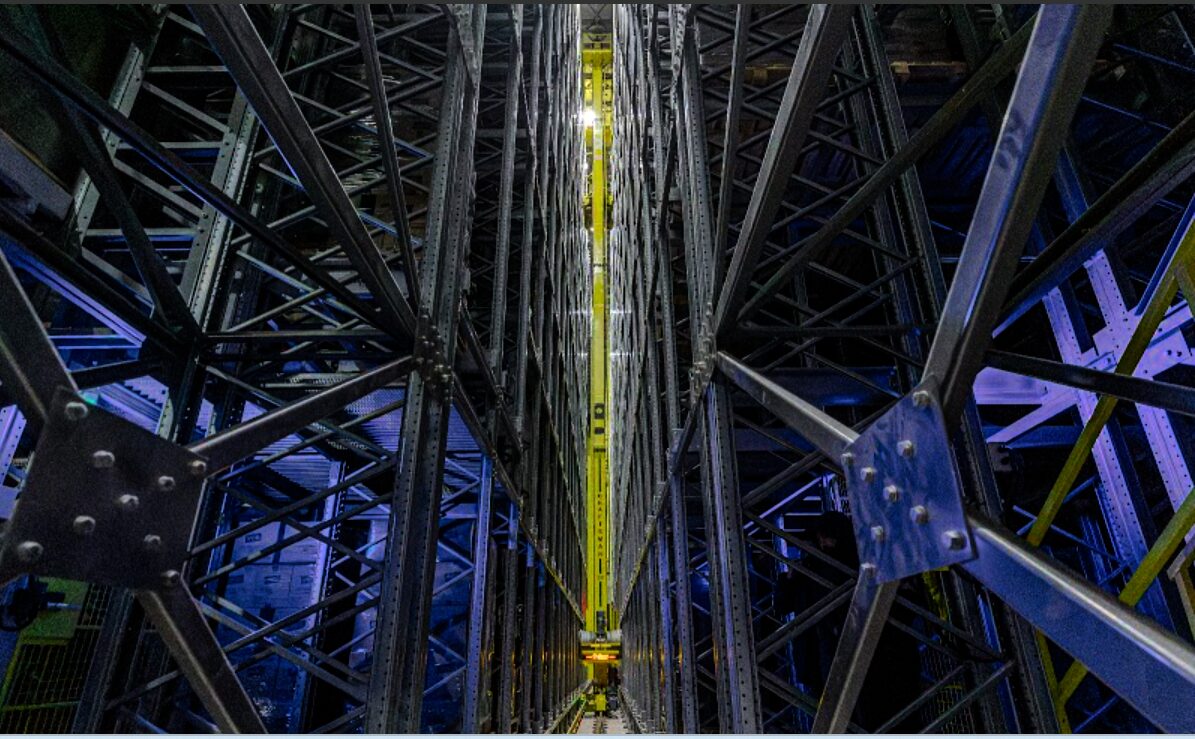
- Automated storage. About 70% of Indicold’s cold storage capacity is automated, with ASRS-equipped, rack-clad chambers that keep product inside the cold zone instead of on an open dock.
- Frozen, chilled and ambient under one roof. Multi-temperature facilities let brands consolidate a dark store’s full requirement on a single run.
- Cross-dock and last mile. Consolidation at Indicold hubs feeds reefer distribution to QSR, retail, pharmacy and distributors.
- Moolcode WMS. Indicold’s own warehouse management system runs ASRS control, slotting, billing and a customer portal, giving brands live inventory by chamber and pallet.
- IoT temperature telemetry. Live sensor data from every chamber and reefer, with alerts and a full audit trail for compliance.
For a brand, that turns the checklist above from a set of questions into a set of reports it can open at any time.
The bottom line
Quick commerce promises the customer ten minutes. The brand’s real promise is everything that happened in the days before: that the pack never warmed, never refroze and never sat on a dock. As regulators start opening dark-store freezers, that promise is being checked.
The brands that win this channel will treat cold-chain quality as part of the product, not a logistics cost. If you are scaling frozen or chilled products on quick commerce, talk to Indicold about city-level storage, consolidation and the temperature data to prove it.
Sources
- Apparel Resources: Q-commerce market to grow 40% in 2026 (Equirus)
- Apparel Resources: Instamart’s share among q-commerce players (Zepto UDRHP order data)
- NewsBytes: Quick commerce crosses 9 million daily orders
- Address Advisors: Quick commerce adds 900 dark stores (citing The Times of India)
- HUL: Quick commerce is one-sixth of e-commerce sales
- Storyboard18: Quick commerce now 3% of HUL’s business
- IMARC: Indian frozen foods market
- IMARC: Ice cream market in India
- IMARC: How big will India’s ice cream industry be by 2033
- The Logical Indian: Ice cream market forecast to 2033
- Indian Retailer: Hocco on quick commerce
- Entrackr: Maharashtra FDA suspends dark-store licences
- Angel One: FDA shuts Blinkit dark store in Pune
- NewKerala: Maharashtra FDA suspends 14 licences
- Sahi: Instamart Bengaluru warehouse sealed
- Omnicuris: Food-safety risks behind the FDA drive
- Hillphoenix: Ice cream product integrity and the cold chain
- IIR FRIDOC: Cyclical temperature fluctuations and ice crystals in ice cream
- Dataful: What food loss reveals about India’s supply chains (NABCONS 2022)