It took me a while, and quite a few cold mornings inside chambers running at minus eighteen, to realise how incomplete that picture was.
A checklist tells you what was done. It doesn't always tell you whether it was done well, or whether the person doing it understood why it mattered. In a cold chain, that difference is everything. A carton of frozen food that has thawed and refrozen can look perfectly fine from the outside. Chilled produce that sat on a dock for forty minutes too long won't announce itself. By the time a problem becomes visible, it is usually too late to fix.
That is the part of this industry that stays with me. We are protecting something that cannot be recovered once it is compromised. You can't chill a product back to safety. You can't undo a temperature excursion. You can only prevent it.
More than a checklist,
For a long time, I measured my work by outputs. How many audits did we clear? How many CAPAs were closed this month? Was every form signed?
These things matter, and I won't pretend they don't. But I have come to see them as evidence of quality, not quality itself. A closed CAPA means very little if the same observation shows up again three months later. A clean audit report doesn't help much if the team only follows the procedure when the auditor is in the building.
What I am really trying to build now is harder to put on a dashboard: an environment where doing the right thing is simply the normal thing.
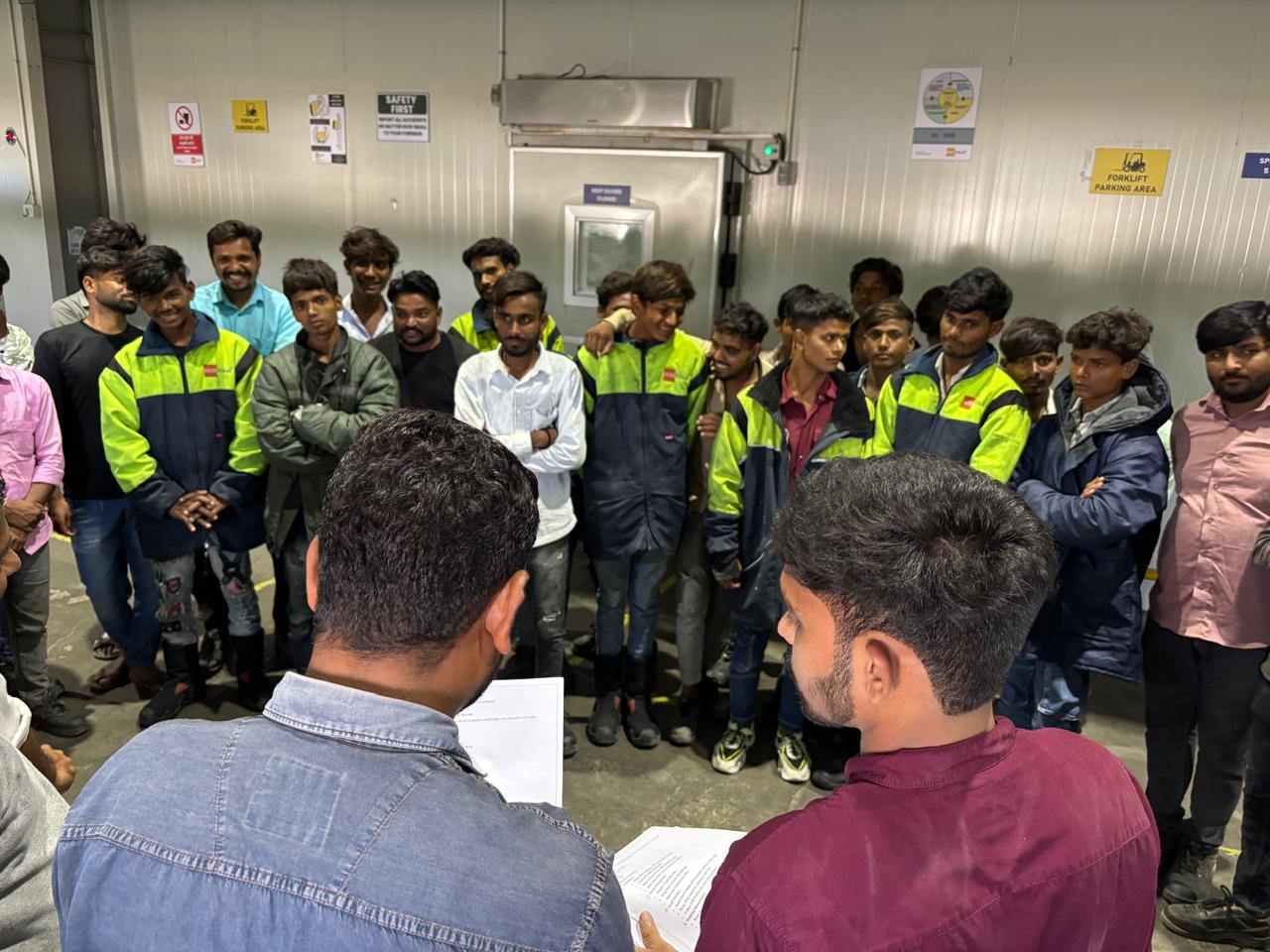
In practice, that means an operator on the dock understands why the door shouldn't stay open while a truck is being repositioned, not just that there is a rule about it. It means we read temperature data as an early warning, spotting a slow drift in a chamber before it becomes a deviation, instead of looking at it only after something has gone wrong. It means treating an audit as a chance to learn about our own system rather than a test to survive. It means corrective actions go after root causes, even when the root cause turns out to be uncomfortable, like a staffing gap or a flaw in the building's design. And it means food safety shows up in everyday decisions, not just in the quality department's files.
None of this happens because Quality writes a better SOP. It happens when people across the operation start to see food safety as part of their own job.
Learning Where the Work Happens
If I could tell someone starting out in this field just one thing, it would be this: spend time on the floor. Every facility I have worked with has taught me something different, and most of those lessons never came from a manual.
Take pest control. On paper, it can look like a vendor contract and a folder of bait-station records. But an observation as simple as activity near one particular dock door can lead you to worn door seals, poor drainage, or the way waste is stored outside. Suddenly you are not talking about pest control anymore. You are talking about infrastructure and preventive design.
Recurring temperature deviations taught me something similar. The first instinct is often to blame the equipment, or to retrain whoever was on shift. Sometimes that is right. But when the same chamber keeps drifting, the real answer usually sits somewhere between engineering and habit. How often is the door opened during peak loading? Are pallets blocking airflow from the evaporators? Is the defrost cycle timed sensibly against the receiving schedule? You only find those answers by standing in the chamber and watching how the work actually happens.
Housekeeping gaps were another eye-opener. A dirty corner or an untidy staging area is easy to write up and easy to clean. But when it keeps coming back, it is rarely about one careless person. More often it points to a training gap, unclear responsibilities, or supervision that is stretched too thin.
Then there are repeat audit findings, which I have learned to take personally, in a good way. When the same observation appears audit after audit, it usually means we have documented a system without fully putting it into practice. The procedure exists. The training records exist. But somewhere between the document and the daily routine, it has quietly fallen apart.
Customer audits added another layer. Regulations tell you the minimum. Customers tell you what they actually expect, and those expectations are often more specific and more demanding. Meeting them consistently, shipment after shipment, is what earns their trust. That changed how I see compliance. It is the floor, not the ceiling.
Seeing the system in everyday things
Somewhere along the way, the warehouse started to look different to me.
A pallet stopped being just a pallet. I would notice whether it was damaged, whether it was stacked to let air circulate, and whether it was sitting in the right zone for the product on it.
A temperature logger stopped being just a device. It became the product's only witness on its journey, the one record that can honestly tell us what happened between our dock and the customer's.
A cleaning checklist stopped being just a record. Behind every line on it is a surface that either is clean or isn't, and a person who either understood why it mattered or didn't.
A pest-control station stopped being just a contractual requirement. It became a small sensor in a larger network, quietly telling us whether the building is doing its job of keeping the outside world out.
Each of these is a control. On its own, none of them looks especially important. Together, they make up the food-safety system. And like any chain, it is only as strong as the link that gets ignored on a busy day.
What I believe now
I still check things. I still prepare for audits, close CAPAs, and care about getting the paperwork right. But I no longer see those as the destination.
Quality isn't the inspector standing at the end of the line deciding what passes. By that point, most of the outcome has already been decided by how the product was received, stored, handled and moved at every step before it. So that is where I try to put my energy now: into the steps before. Into helping people understand the why. Into using data to catch risks early. Into fixing causes rather than symptoms.
At Indicold, we talk about being reliable, transparent and innovative. Working in cold-chain quality, I have come to see those values in very practical terms. Reliable means the product is protected every single time, not just on audit day. Transparent means our data tells the truth, even when it is inconvenient. Innovative means we keep asking how we can do better, before a failure forces the question.
Quality is not a final checkpoint. It is the system that protects every step before the final checkpoint. Building that system, one habit and one conversation at a time, has been the most meaningful part of my work.
Author - Vishal Tamilselvan, Quality Analyst